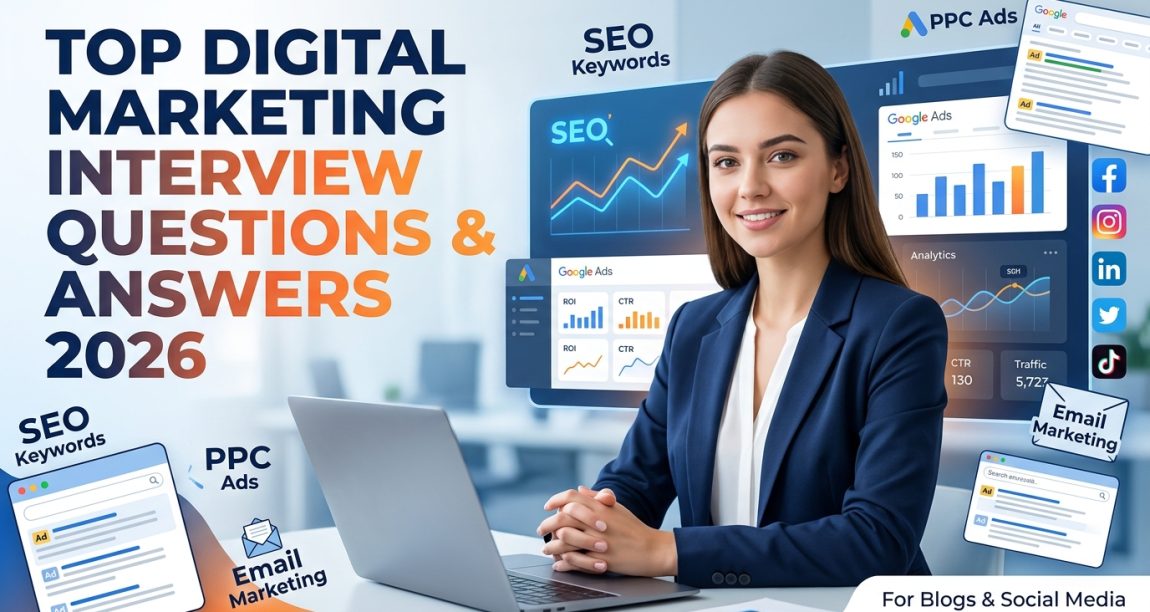
Preparing for a digital marketing interview can feel overwhelming because the field covers multiple areas including SEO, PPC, social media, content marketing, analytics, and email marketing. Employers are not only looking for candidates with theoretical knowledge but also professionals who can apply marketing strategies to achieve real business results.
Whether you are a fresher entering the industry or an experienced marketer aiming for leadership roles, understanding the most common digital marketing interview questions can significantly improve your confidence and performance.
Many companies today also partner with a digital recruitment agency to find skilled digital marketing professionals. This means candidates must be prepared to answer practical, analytical, and scenario-based questions during interviews.
This guide covers the most important digital marketing interview questions and answers to help you succeed in your next interview.
What is Digital Marketing?
Answer:
Digital marketing is the process of promoting products or services through online channels such as search engines, websites, social media platforms, email, and paid advertising.
The main goal of digital marketing is to:
- Reach targeted audiences
- Generate leads
- Increase sales
- Build brand awareness
- Improve customer engagement
Digital marketing includes several important areas such as:
- SEO (Search Engine Optimization)
- PPC (Pay-Per-Click Advertising)
- Content Marketing
- Social Media Marketing
- Email Marketing
- Affiliate Marketing
Businesses hiring through digital marketing agency recruitment services often look for candidates who have knowledge across multiple marketing channels.
What is SEO?
Answer:
SEO, or Search Engine Optimization, is the process of improving a website’s visibility in search engine results pages like Google.
The purpose of SEO is to increase organic traffic by improving rankings for relevant keywords.
SEO can be divided into three major areas:
On-Page SEO
- Keyword optimization
- Meta titles and descriptions
- Internal linking
- Content optimization
Off-Page SEO
- Backlink building
- Brand mentions
- Social signals
Technical SEO
- Website speed
- Mobile-friendliness
- Crawlability
- Site structure
Companies hiring through head of seo recruitment specialists usually prioritize candidates with strong SEO strategy and technical knowledge.
What is the Difference Between SEO and PPC?
Answer:
SEO focuses on improving organic rankings, while PPC involves paid advertisements that appear in search engine results.
| SEO | PPC |
| Organic traffic | Paid traffic |
| Long-term strategy | Immediate results |
| Takes time | Instant visibility |
| No direct ad cost | Requires advertising budget |
Professionals working in paid advertising are often recruited through head of pay per click recruitment services for senior PPC leadership roles.
How Do You Measure the Success of a Marketing Campaign?
Answer:
Marketing campaign success is measured using KPIs (Key Performance Indicators).
Common KPIs include:
- Website traffic
- Conversion rate
- Cost per acquisition (CPA)
- Return on investment (ROI)
- Click-through rate (CTR)
- Engagement rate
- Bounce rate
- Lead generation
Employers want candidates who can analyze data and optimize campaigns based on performance.
What Tools Have You Used in Digital Marketing?
Answer:
Some of the most commonly used digital marketing tools include:
Analytics Tools
- Google Analytics 4
- Google Search Console
- Looker Studio
SEO Tools
- SEMrush
- Ahrefs
- Moz
Advertising Tools
- Google Ads
- Meta Ads Manager
- LinkedIn Campaign Manager
Content & Email Tools
- Mailchimp
- HubSpot
- Canva
Candidates applying for leadership positions such as head of ecommerce jobs are often expected to have experience with analytics, automation, and conversion optimization tools.
What is Content Marketing?
Answer:
Content marketing is a strategy focused on creating valuable and relevant content to attract and engage audiences.
Examples of content marketing include:
- Blog posts
- Videos
- Infographics
- Social media content
- Ebooks
- Podcasts
The goal is to educate users, build trust, and generate leads over time.
What is Email Marketing?
Answer:
Email marketing is the practice of sending targeted emails to customers and prospects.
It is commonly used for:
- Lead nurturing
- Promotions
- Customer retention
- Product announcements
- Newsletters
Successful email marketing campaigns usually include:
- Personalized messaging
- Audience segmentation
- Strong call-to-actions
- A/B testing
What is Conversion Rate Optimization (CRO)?
Answer:
Conversion Rate Optimization is the process of improving websites or landing pages to increase the percentage of visitors who complete a desired action.
Examples include:
- Filling out a contact form
- Signing up for a newsletter
- Making a purchase
CRO strategies often involve:
- A/B testing
- Improving page speed
- Better user experience
- Stronger CTAs
Explain Google Ads.
Answer:
Google Ads is Google’s online advertising platform where businesses can run paid ads on search results, YouTube, and partner websites.
Google Ads uses a PPC model where advertisers pay only when users click on their ads.
Benefits of Google Ads include:
- Fast traffic generation
- Audience targeting
- Measurable results
- Flexible budgets
How Do You Stay Updated With Digital Marketing Trends?
Answer:
Digital marketing changes rapidly, so continuous learning is essential.
Professionals usually stay updated by:
- Reading marketing blogs
- Following industry experts
- Attending webinars
- Listening to podcasts
- Taking certification courses
- Testing new tools and strategies
Interviewers ask this question to understand whether candidates are proactive and adaptable.
What Are Backlinks?
Answer:
Backlinks are links from external websites pointing to your website.
Search engines consider backlinks as signals of trust and authority. High-quality backlinks from relevant websites can improve SEO rankings and organic visibility.
What Are Long-Tail Keywords?
Answer:
Long-tail keywords are highly specific search phrases with lower search volume but higher conversion intent.
For example:
- Short keyword: “SEO”
- Long-tail keyword: “best SEO tools for ecommerce websites”
Long-tail keywords usually:
- Have less competition
- Attract targeted users
- Improve conversion rates
Why Should We Hire You?
Sample Answer:
“I have a strong understanding of SEO, PPC, social media, and analytics. I am highly analytical, adaptable, and focused on delivering measurable results. I enjoy learning new marketing trends and using data-driven strategies to improve campaign performance.”
Common Scenario-Based Digital Marketing Interview Questions
What Would You Do If a Campaign Performed Poorly?
Answer:
I would first analyze campaign data to identify the issue. This could involve checking targeting, ad creatives, landing pages, keywords, or audience engagement.
Then I would:
- Review KPIs
- Conduct A/B testing
- Optimize targeting
- Improve messaging
- Adjust bidding strategies
A structured and analytical approach is important for solving campaign issues effectively.
How Would You Handle a Limited Advertising Budget?
Answer:
With a limited budget, I would focus on:
- High-intent keywords
- Retargeting campaigns
- Audience segmentation
- Conversion optimization
- Performance monitoring
The goal would be to maximize ROI while minimizing wasted ad spend.
Tips to Succeed in a Digital Marketing Interview
Here are some useful interview preparation tips:
- Research the company before the interview
- Understand current marketing trends
- Prepare campaign examples and case studies
- Practice explaining technical concepts simply
- Learn basic analytics reporting
- Stay updated on SEO and PPC changes
Candidates applying through a digital recruitment agency often face multiple interview rounds, so preparation is essential.
Conclusion
Digital marketing interviews test both theoretical knowledge and practical problem-solving skills. Employers want candidates who understand marketing fundamentals and can apply strategies that drive measurable business growth.
From SEO and PPC to analytics and content marketing, preparing strong answers to common interview questions can improve your confidence and increase your chances of getting hired.
Whether you are applying for entry-level opportunities or senior leadership roles through digital marketing agency recruitment, proper preparation can help you stand out in a competitive job market.